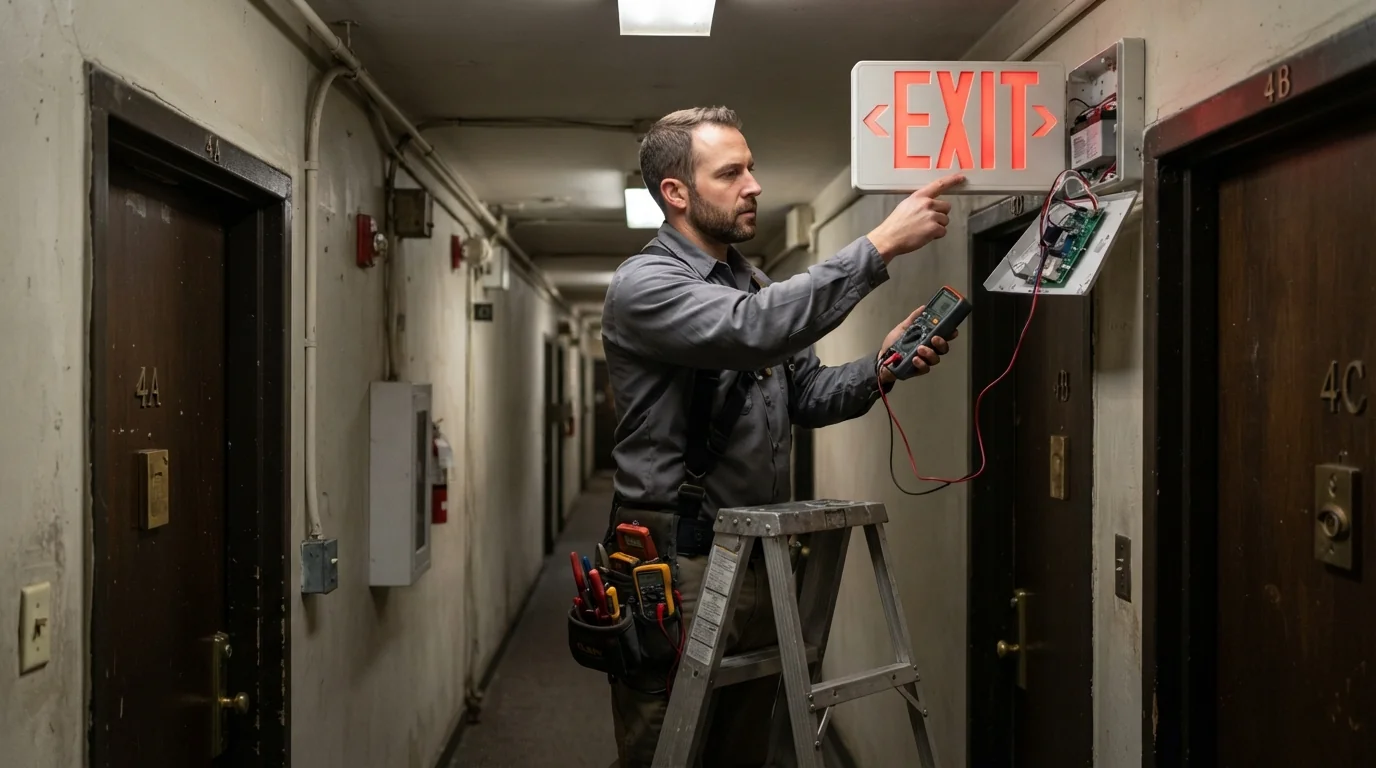
Emergency and exit lighting in New York City keeps exit routes lit and marked when normal power fails, using battery units, inverters or generator-backed circuits. The common standard calls for a brief monthly test and a longer annual test with results logged, and NYC service calls typically run $100 to $200 an hour standard.
Updated September 2026
Emergency lighting is invisible until the day it matters, which is why so much of it fails quietly. Batteries age, lamps burn out and signs get knocked or painted over.
We survey the building, replace what's failed, fill the gaps in coverage, and set up a testing routine with logs, so the next inspection finds a working system and a record to prove it.
Battery and inverter units
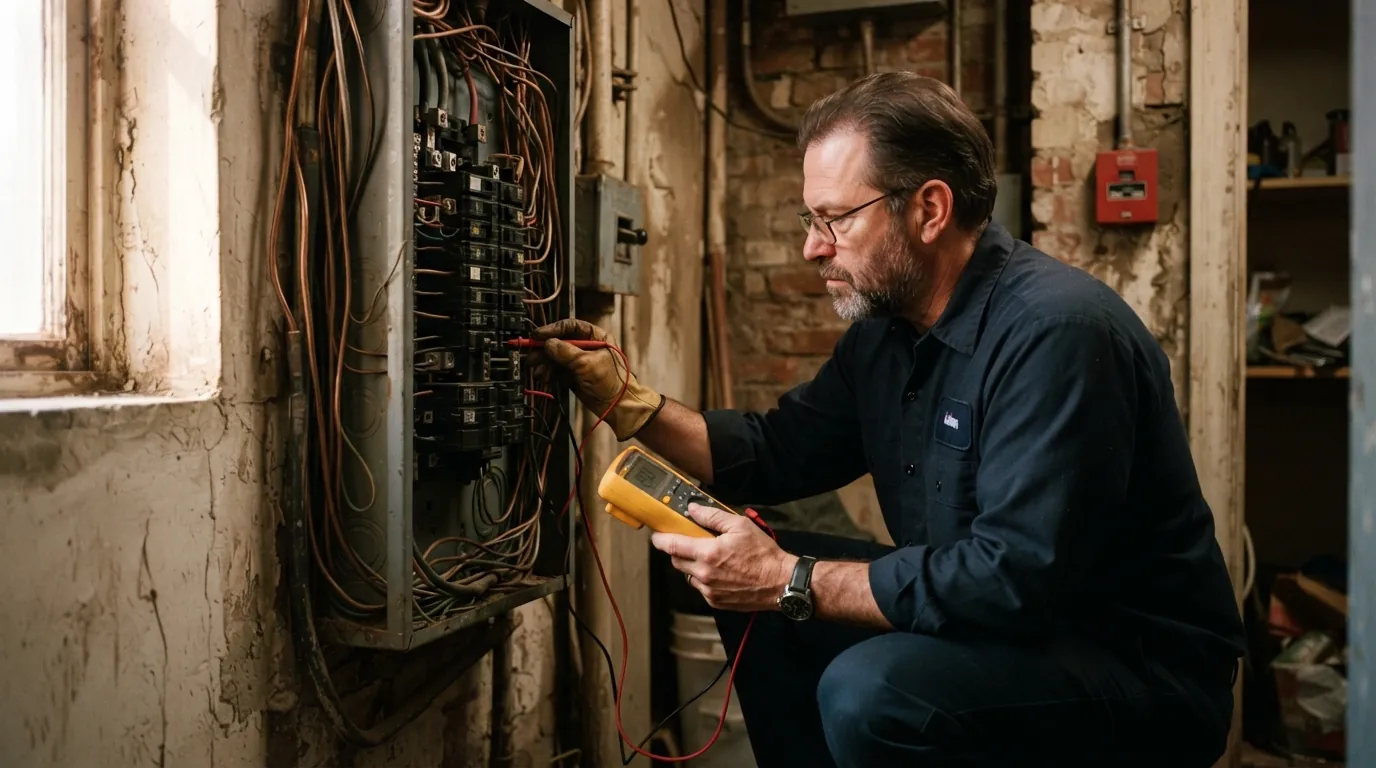
Most buildings use self-contained battery units: a fixture or exit sign with its own battery that switches on when power fails. Larger buildings may use a central inverter that powers designated fixtures from one battery bank. Each has trade-offs in cost, maintenance and testing. We replace failed units, recommend a central inverter where the number of units makes battery replacement a recurring headache, and make sure every emergency fixture is on the circuit that serves the area it lights. Batteries are dated when installed so replacements can be planned.
$100 to $200 per hour standard; $200 to $400 per hour emergency or after hours; service call minimum $150 to $300. Source: aecontractorsnyc.com, 2026-09. Published market range for budgeting only, not our quote.
Exit sign replacement
Old incandescent and fluorescent exit signs use more power and fail more often than LED signs, which last for years on very little energy. We replace signs with LED models, combination sign-and-light units where a corridor needs both, and add directional arrows where the route isn't obvious. Signs are mounted where they're visible from the path of travel, not hidden above a door that opens outward, and each is tested on battery before we leave. Old signs are removed and recycled.
Monthly and annual testing
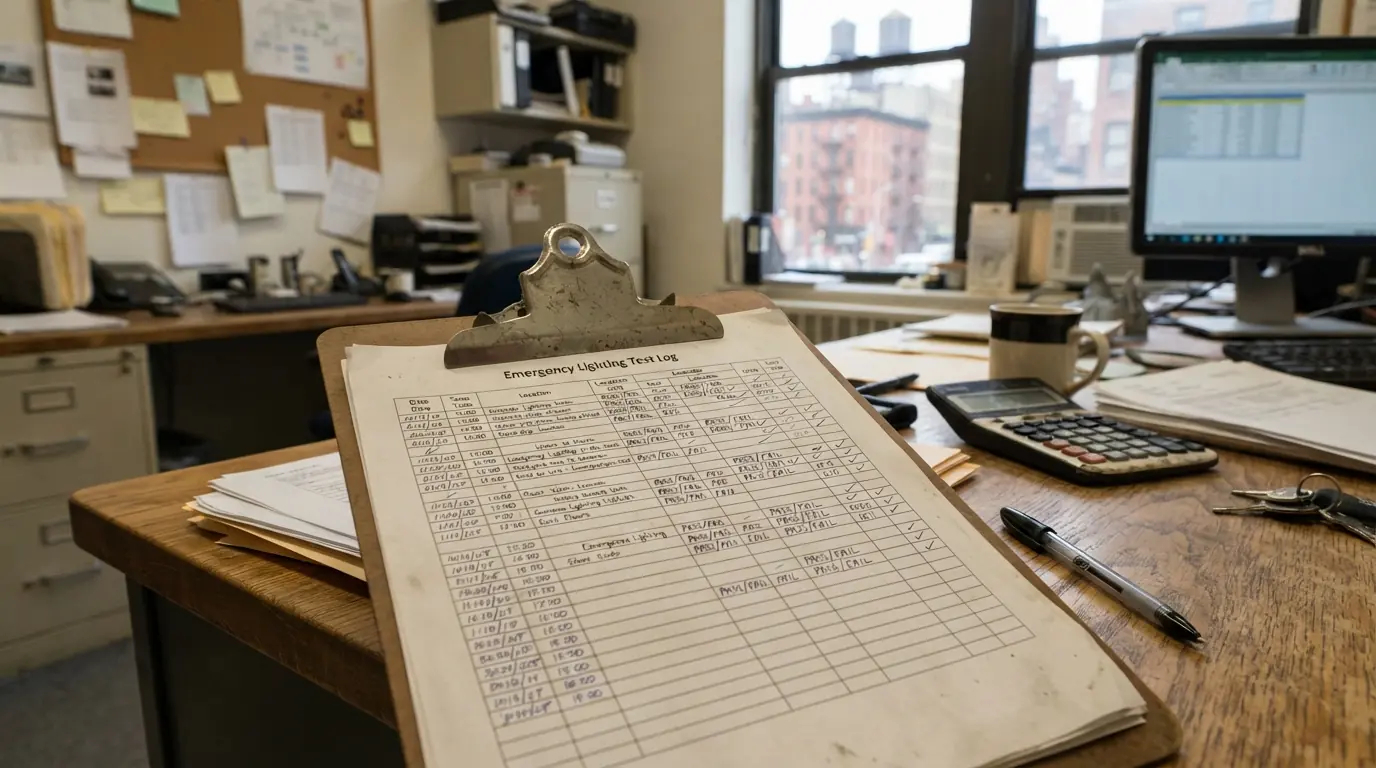
The common standard, NFPA 101, calls for a functional test of every emergency light and exit sign every month for at least 30 seconds, and a full 90-minute battery test once a year. We can run both, log the results by fixture, and replace anything that fails. For buildings that want less labor, self-testing units run their own monthly checks and flag failures with an indicator light, which leaves a quick visual check and the annual test. Failed units are listed with their location for quick repair.
Stairwell and corridor coverage
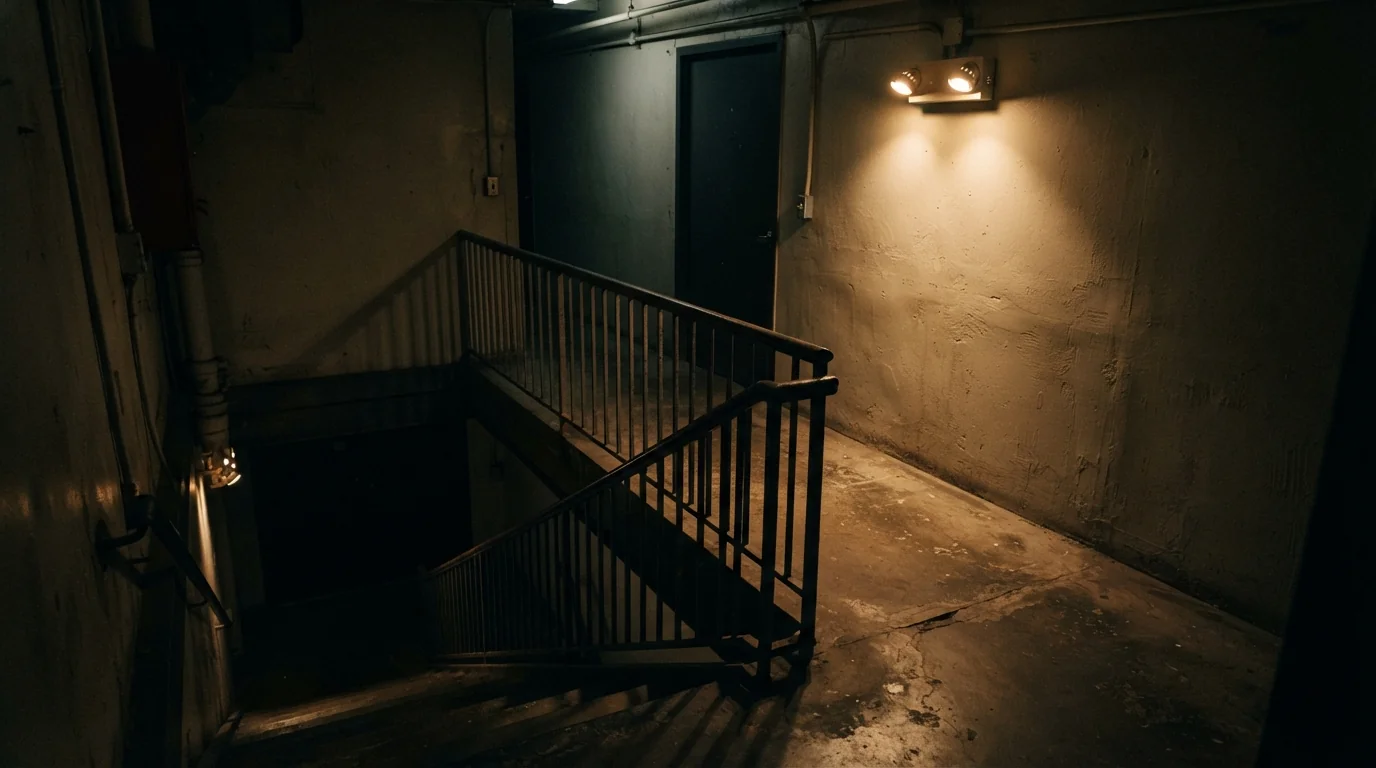
Stairwells and corridors are the exit path, and coverage gaps usually show up at landings, turns and the final exit door. We walk the path with the lights off where possible, note dark spots, and add units so the whole route stays lit when power fails. Exterior discharge lighting at the building exit is part of the same route. The result is a plan of every emergency fixture, which makes the next test faster and shows an inspector the coverage at a glance.
What moves the price
- Number of units and exit signs
- Battery units versus a central inverter
- Self-testing or manual-test units
- Coverage gaps to fill
- Stairwell and exterior discharge lighting
- Testing and logging frequency
- After-hours work in occupied buildings
$100 to $200 per hour standard; $200 to $400 per hour emergency or after hours; service call minimum $150 to $300. Source: aecontractorsnyc.com, 2026-09. Published market range for budgeting only, not our quote.
What building staff can check
| Check | How | Call us if |
|---|---|---|
| Exit signs | Walk the route and look for dark letters | Any sign is dark or dim |
| Test button | Press and hold for 30 seconds | A unit doesn't light or dims fast |
| Indicator lights | Check self-test units for a fault light | Any unit shows a fault |
| Log | Record each monthly check | You're missing months |
What we see in New York buildings
Exit signs are part of the city's lighting rules too. Local Law 88 required buildings of 25,000 square feet or more to bring their lighting up to the energy code by January 1, 2025, and the upgrades it covers include LED conversion, lighting controls, automatic shutoff, exterior lighting and exit signs. For many owners, that made exit-sign replacement part of a wider lighting project rather than a one-off repair.
What happens after you call
- 1
Survey the exit path
Every sign and unit located and tested.
- 2
Coverage plan
Gaps at landings, turns and exits identified.
- 3
Replace and add
Failed units replaced, gaps filled with LED units.
- 4
Full test
Every unit tested on battery.
- 5
Log and schedule
Results logged and the testing routine set.
How long a survey and upgrade takes
Surveying and testing a small building usually takes a few hours; a large building with many stairwells takes a day or more. Replacing failed units and filling gaps is typically done in one or two visits. The annual 90-minute test is scheduled at a quiet time, and in occupied buildings we test floor by floor so no stair is ever without lighting.
Questions about emergency & exit lighting in New York
The common standard is 30 seconds monthly and 90 minutes once a year.
Yes. We log results by fixture and building.
In larger buildings they cut monthly labor. The annual test still applies.
It can make sense with many units. We compare it with battery units.
Yes, and they use much less power than older signs.
Yes. Testing and replacement can be done after hours.