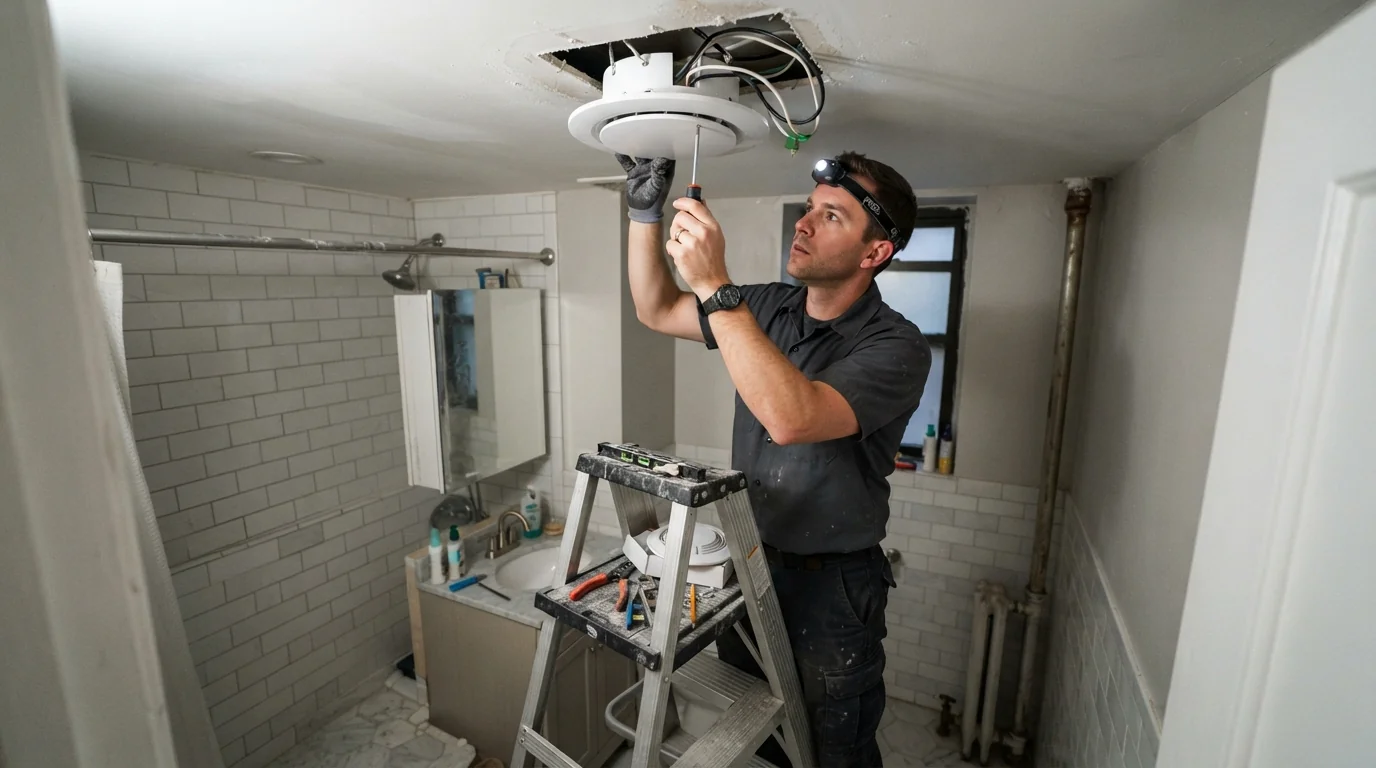
Installing a bathroom exhaust fan in New York City means choosing a fan sized for the room, venting it to the outdoors or to the building's exhaust shaft, and wiring it on a switch, timer or humidity control. In apartments the vent route decides most of the job. Fans with built-in lights count as light fixtures, which in homes must be high-efficacy.
Updated September 2026
A bathroom fan only works if the air it moves goes somewhere. Many older bathrooms have a fan that vents into the ceiling cavity, or a shaft grille with nothing behind it pulling air.
We look at the route first: the shaft, an outside wall or the roof. Then we pick a fan with the airflow and quiet rating the room needs, wire it on a control that runs long enough, and seal the ceiling around it.
New fan where there is none
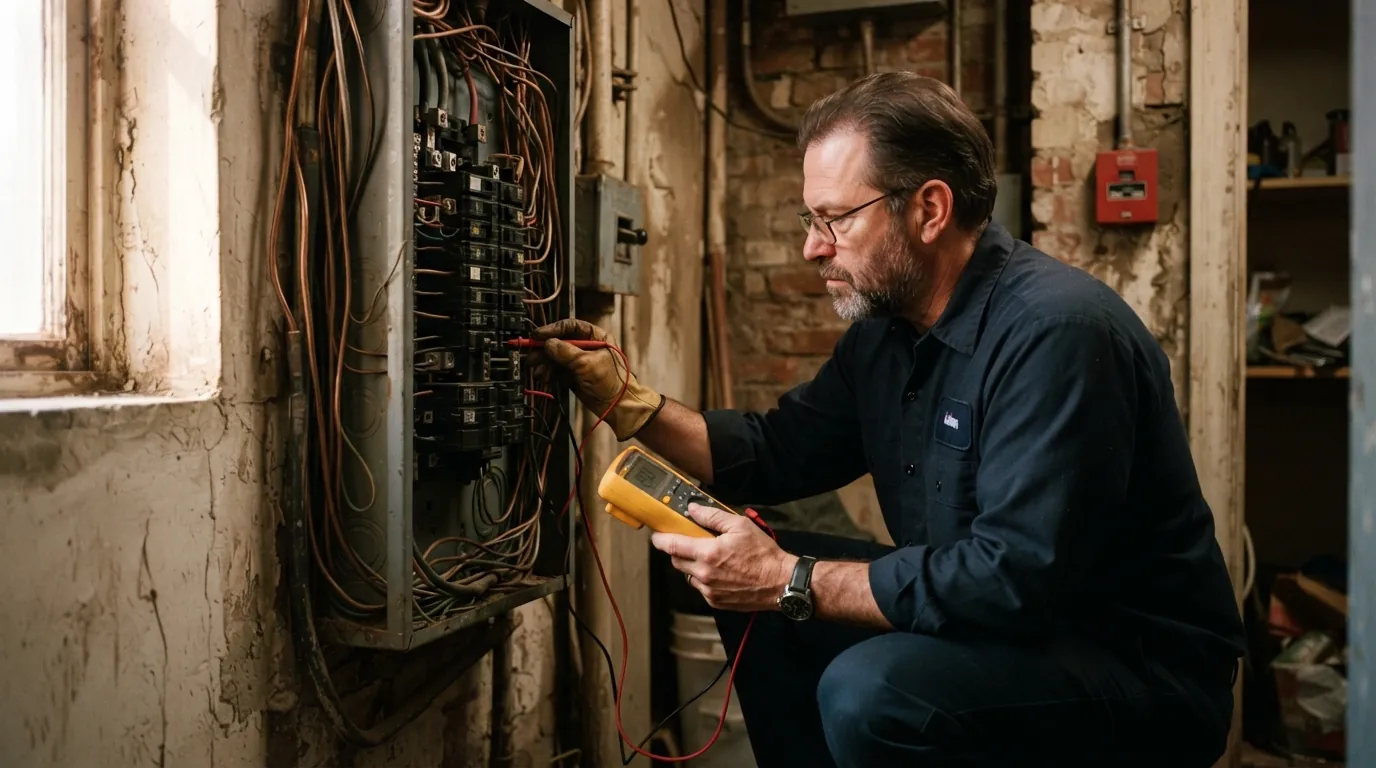
Adding a fan to a bathroom that never had one starts with the vent route. In a house, that's usually through an outside wall or up to the roof. In an apartment building, it's often the existing exhaust shaft, subject to the building's rules. We cut the ceiling opening, run the duct, mount a fan sized for the room, and bring power from the nearest suitable circuit. The ceiling is left ready for a touch-up rather than a patch job across the whole bathroom.
light fixture $155 to $955; ceiling fan $140 to $350; outlets $200 to $300; switches $85 to $200. Source: www.homeadvisor.com, 2025. Published market range for budgeting only, not our quote.
Fan replacement and upgrades
Old fans are loud, weak and often clogged with dust. Replacement fans are much quieter and move more air for the same size opening, and many fit the existing housing with a retrofit kit, which keeps the ceiling intact. We check that the old duct actually reaches the outside or the shaft, clear or replace it, and install the new fan. If you want a light or a heater in the same unit, we confirm the circuit can carry it before choosing the model.
Humidity and timer controls
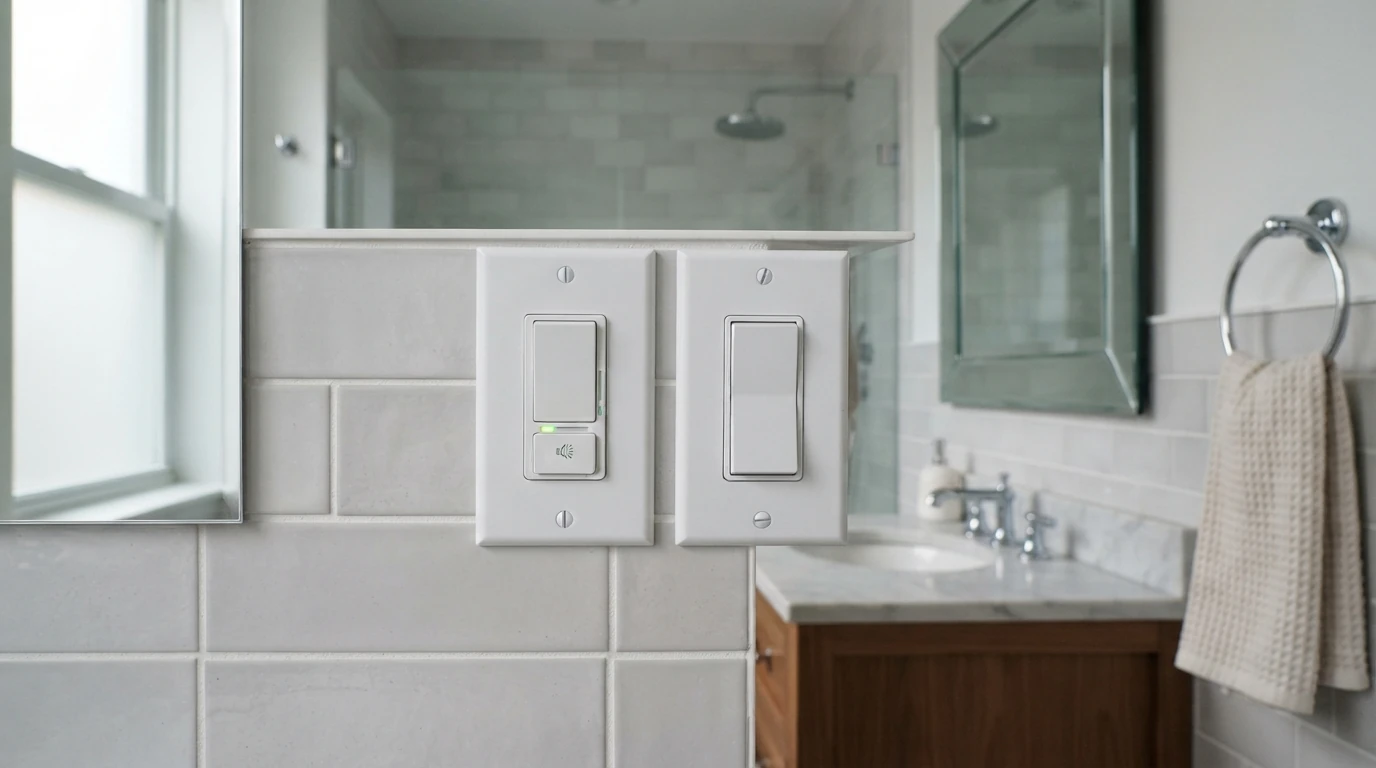
Most fans don't run long enough. People switch them off when they leave the bathroom, and the moisture stays behind to feed mold and peel paint. A countdown timer keeps the fan running for a set time after a shower, and a humidity-sensing control turns it on and off by itself. We wire the control you prefer, set the timing to the room, and keep the fan and light on separate switches so the light doesn't have to stay on for the fan to run.
Venting through shafts and walls
Where the air goes matters more than the fan. Venting into an attic or ceiling cavity just moves the moisture somewhere it can rot framing and grow mold. We route ducts to the outside or to the building's exhaust shaft, keep runs short with as few bends as possible, and fit a damper so outside air and neighbors' odors don't come back in. In co-ops, shaft connections follow the building's rules, which we confirm with the super or managing agent first.
What moves the price
- New installation or replacement
- Vent route: shaft, outside wall or roof
- Ceiling type and access above
- Fan size, noise rating and features
- Timer or humidity control
- New circuit or existing one
- Building rules for shaft connections
light fixture $155 to $955; ceiling fan $140 to $350; outlets $200 to $300; switches $85 to $200. Source: www.homeadvisor.com, 2025. Published market range for budgeting only, not our quote.
What you can check yourself
| Check | How | What it tells us |
|---|---|---|
| Airflow | Hold a tissue to the grille with the fan on | Whether the fan moves air at all |
| Noise | Listen for rattling or humming | Whether the motor is failing |
| Fog time | Time how long the mirror stays fogged | Whether the fan is undersized or blocked |
| Outside vent | Look for a flap on the wall or roof | Whether it vents outdoors |
What we see in New York buildings
Fans with built-in lights are covered by New York City's energy rules for home lighting. DOB energy-code guidance requires 100 percent of the permanently installed light fixtures in residential buildings and dwelling units to be high-efficacy: lamps of at least 65 lumens per watt, or whole fixtures of at least 45. Most current fan-light combinations use LED modules that meet that, but older fan-lights with incandescent sockets do not.
What happens after you call
- 1
Check the vent route
Shaft, wall or roof, and what the building allows.
- 2
Size the fan
Airflow and noise rating matched to the room.
- 3
Install the duct
Short, sealed run with a damper.
- 4
Mount and wire
Fan set, control wired, ceiling sealed.
- 5
Test the airflow
Fan run and draw checked at the grille.
How long a fan installation takes
Replacing a fan in an existing housing usually takes a couple of hours. A new fan with a new duct to an outside wall or the shaft takes most of a day, longer if the route crosses finished ceilings. Controls add little time. If the building needs to approve a shaft connection, we allow for that before booking the work.
Questions about bathroom exhaust fan installation in New York
If it has no window that opens, it almost always does.
No. It should vent outdoors or into the building's exhaust shaft.
Old motors, clogged ducts or a duct that doesn't reach outside.
Yes, a countdown timer or a humidity-sensing control.
Often, with a retrofit kit that keeps the ceiling intact.
Usually for shaft connections. We check with the super first.