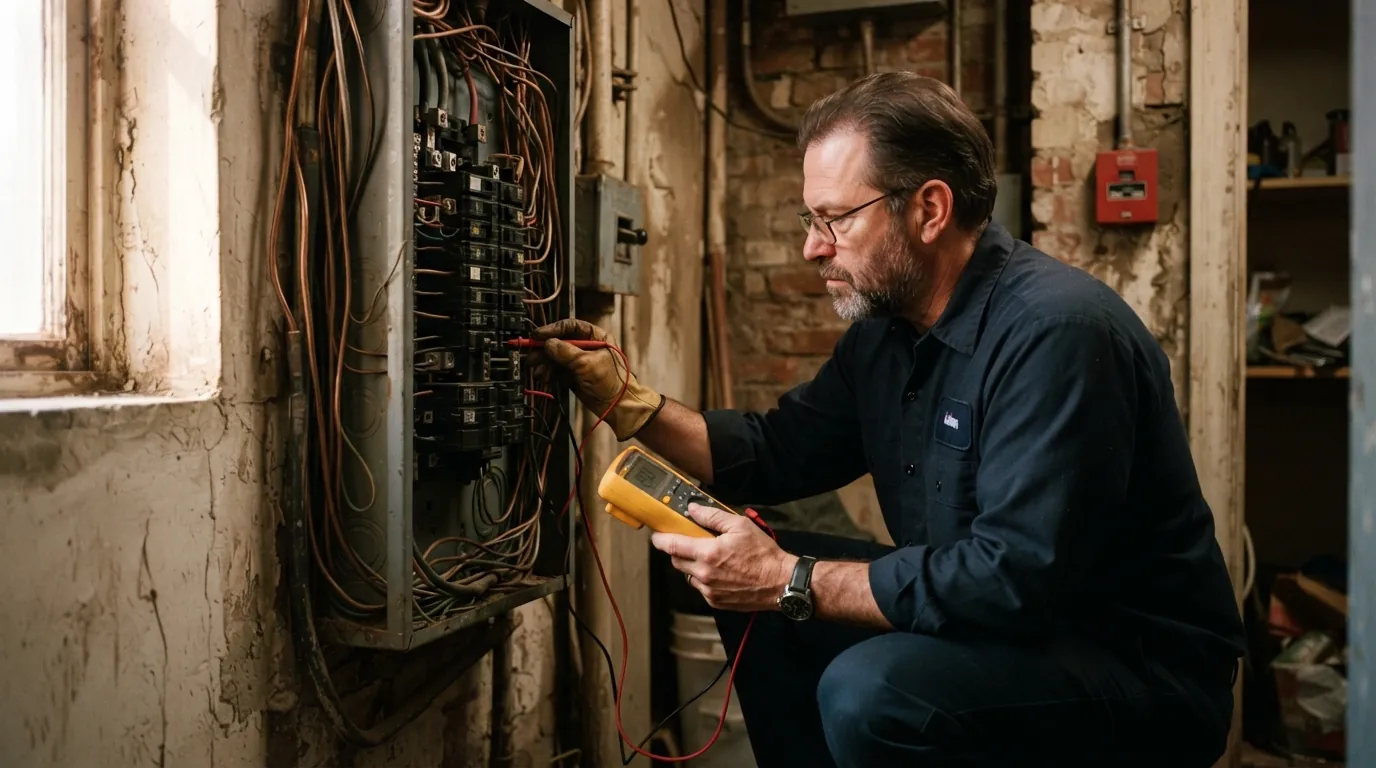
Air conditioner circuits in New York City are dedicated lines sized to the unit's nameplate, ending in the receptacle that matches its plug, often 240 volts for through-wall units. Window units must be supported with brackets or rails, and in buildings six stories or taller they fall under the facade inspection program, so boards often set rules for both.
Updated September 2026
An air conditioner draws more current than almost anything else on a bedroom or living-room circuit, especially when its compressor starts. Shared with lights and outlets, it trips breakers and heats connections.
We give each unit its own circuit, install the receptacle its plug and voltage call for, and check the panel can carry the load when every unit in the apartment runs at once.
Through-wall AC outlets
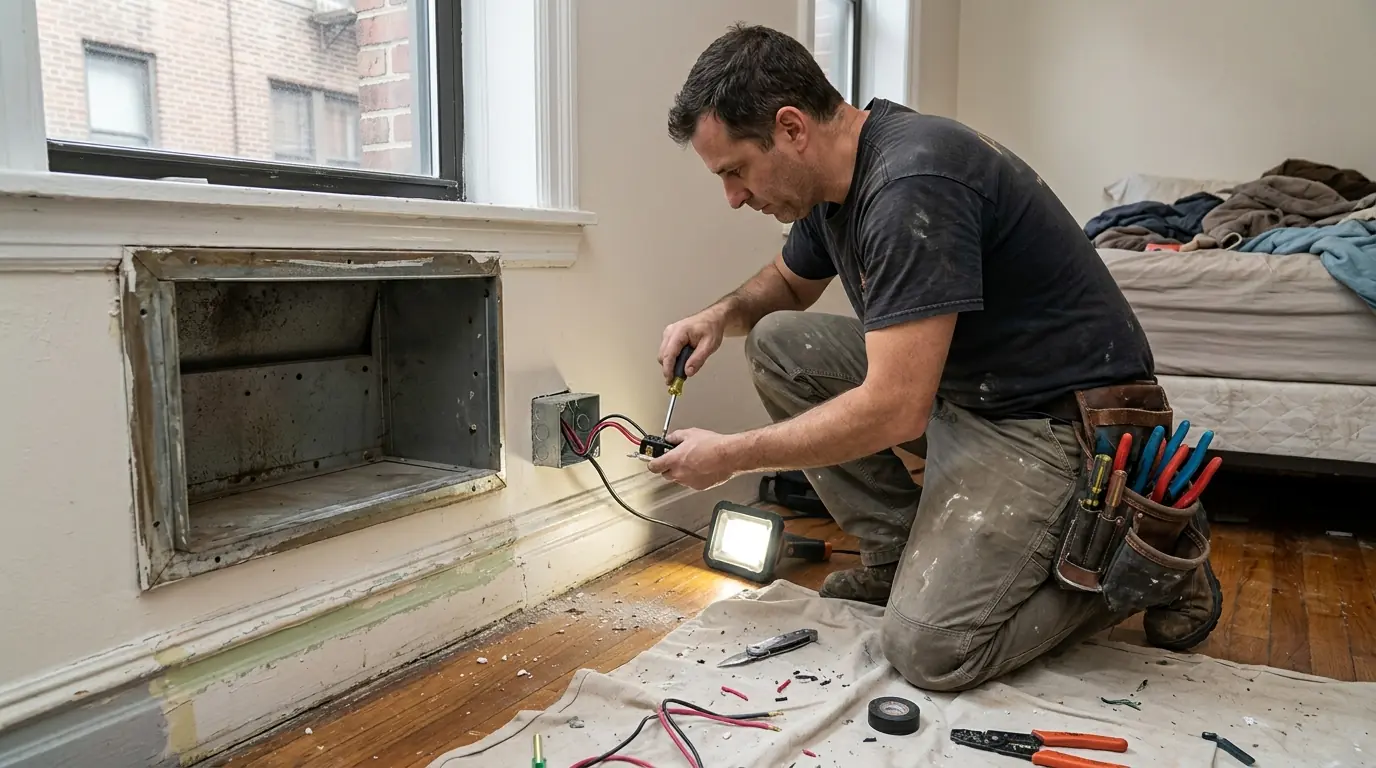
Through-wall units sit in a sleeve and often need a 240-volt receptacle with a specific plug shape, rated for the unit's current. When an old sleeve gets a new unit, the receptacle frequently does not match, and people resort to adapters that should never carry that load. We install the correct receptacle on a dedicated circuit sized to the new unit's nameplate, replace the old wiring if it cannot carry it, and confirm the voltage at the outlet before the unit goes in.
GFCI replacement about $100 to $200; standard outlet $100 to $150; three-way switch $200 to $225; 220V outlet $120 to $170. Source: www.homeyou.com, 2026-06-14. Published market range for budgeting only, not our quote.
Window unit circuits
Large window units belong on their own circuit, not on the bedroom circuit with the lamps and the phone charger. We run a dedicated circuit to an outlet near the window, sized to the unit, with a receptacle that matches its plug. In plaster-walled apartments we fish the new cable through the walls or use surface raceway where the building prefers it, and we keep the outlet close enough that no extension cord is ever needed. Old outlets that were overloaded are checked and replaced at the same visit.
Replacing undersized AC receptacles
A scorched, loose or discolored outlet behind an air conditioner is a warning, not a cosmetic problem. It usually means the receptacle or the wiring is undersized, or a connection has been heating every summer. We replace the receptacle with one rated for the load, inspect the wiring and connections back to the panel, and correct the circuit if it was never sized for an air conditioner in the first place. If the circuit cannot be fixed in place, a new dedicated line replaces it. You get a note of what we found behind the outlet.
Building rules and approvals
Many co-ops and condos control which units can be installed, where they go and who installs them, and some require a new circuit to be filed and approved before work starts. We work within the building's rules, supply the insurance certificate and documentation the managing agent asks for, and coordinate with the super on access and power shutoffs. Where the building's riser limits added air conditioning, we tell you before you buy a unit it cannot carry. Shutoffs are scheduled with the super so neighbors are not surprised.
What moves the price
- Number of units and their ratings
- 120-volt or 240-volt circuits
- Distance from the panel
- Plaster walls or surface raceway
- Panel space and capacity
- Building rules and filing
- Old receptacles and wiring to replace
GFCI replacement about $100 to $200; standard outlet $100 to $150; three-way switch $200 to $225; 220V outlet $120 to $170. Source: www.homeyou.com, 2026-06-14. Published market range for budgeting only, not our quote.
What to check before we visit
| Check | Where | Why it matters |
|---|---|---|
| Unit nameplate | Side or back of the AC | Sets the circuit and receptacle |
| Plug shape | The AC cord | Must match the outlet |
| Breaker that trips | Your panel | Shows which circuit it shares |
| Outlet condition | Behind the unit | Scorching means heat damage |
What we see in New York buildings
Department of Buildings guidance says window air conditioners must be supported from underneath with metal brackets or mounting rails, and in buildings six stories or taller they fall under the Local Law 11 facade inspection program. That is why so many New York City buildings regulate air conditioners closely, and why boards increasingly prefer through-wall sleeves and dedicated circuits to a window unit on an overloaded bedroom outlet.
What happens after you call
- 1
Read the nameplates
Voltage, current and plug type for each unit.
- 2
Check the panel
Space and capacity for every unit running.
- 3
Plan the routes
Concealed in walls or in surface raceway.
- 4
Install circuits
Dedicated lines and matching receptacles.
- 5
Test under load
Units run together while we watch the panel.
Signs an AC circuit needs attention
Breaker trips when the unit starts
The circuit is shared or undersized.
Warm or scorched outlet
A connection is overheating.
Adapter or extension cord in use
The outlet does not match the unit.
Lights dim when the compressor kicks on
The circuit is overloaded.
Burning smell near the unit
Unplug it and call.
New unit on an old sleeve outlet
Voltage or plug may not match.
Cord feels hot to the touch
The plug or outlet is undersized.
Questions about air conditioner circuits & outlets in New York
Large window and through-wall units should have one.
The unit shares a circuit or the circuit is undersized.
No. Install the receptacle the unit's plug requires.
Yes. Stop using it and have the outlet and wiring checked.
Many do. We work within the building's process.
Yes, after checking the panel can carry them together.