Installing a home battery in New York City means choosing a listed battery system, wiring it with a backup loads panel for the circuits you want during an outage, and getting the Department of Buildings' acceptance under rules that took effect in October 2025. Every battery at a one- or two-family home is covered regardless of size, and location limits apply.
Updated September 2026
A battery is not a generator: it stores a fixed amount of energy, so the design starts with what you need to keep running and for how long.
We size the system to those circuits, find a location the rules allow, wire a backup loads panel and the transfer equipment, and take the installation through the city's acceptance process.
Battery or generator?
| Option | Best for | Trade-off |
|---|---|---|
| Battery | Quiet backup and solar pairing | Fixed run time unless recharged |
| Standby generator | Long outages and whole-home loads | Fuel, noise and maintenance |
| Battery plus solar | Long outages with sun | Highest upfront cost |
Battery systems for one- and two-family homes
Most home batteries in the city go into one- and two-family houses, where there is a basement, garage or exterior wall to put them on. Location matters as much as size, because the rules limit where lithium-ion systems can go and how much capacity can sit in one space. We look at your house, your panel and your goals, recommend a system and a location that meet the rules, and explain what it will and will not keep running during an outage.
$150 to $300 for a new circuit or minor work; $300 to $600 for a panel upgrade. Source: aecontractorsnyc.com, 2026-09. Published market range for budgeting only, not our quote.
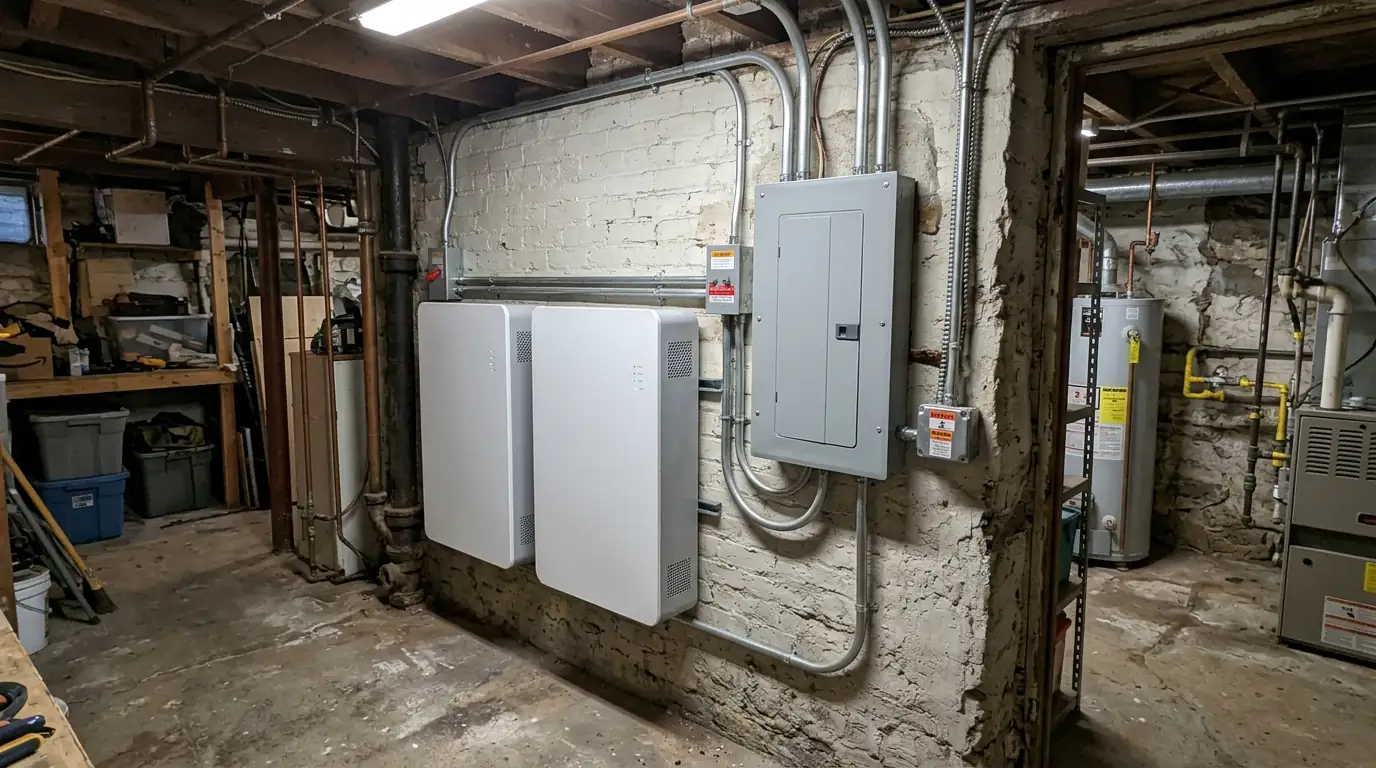
Backup loads panel
Few batteries can run a whole house, so the circuits that matter are moved to a separate backup loads panel: refrigerator, lights, internet, boiler or furnace controls, a few outlets and medical equipment if needed. When the grid fails, the battery feeds only that panel. We help you choose the circuits, size them against the battery's capacity and output, and label the panels so everyone in the house knows what stays on and what does not. Circuits can be swapped later if your needs change.
Pairing a battery with solar
A battery paired with solar can recharge during a long outage instead of running down. Hybrid inverters or AC-coupled batteries each connect differently to an existing solar system, and the panel and interconnection have to be reviewed again when storage is added. We check how your solar was connected, recommend the coupling method that fits, and file the electrical work so the combined system is inspected and approved together. If the existing system needs changes to accept storage, we explain them before anything is ordered. The utility is told about the change where required.
DOB acceptance and FDNY rules
New York City regulates energy storage more tightly than national codes. Since October 2025 the Department of Buildings reviews every battery at a one- or two-family home, with a conditional acceptance before the permit and a final acceptance after the system is certified. We prepare the submission, install to the accepted design, and handle the inspection and close-out, so the system is legal to run and documented for your insurer. You get copies of both acceptance letters with the inspection records.
What moves the price
- Battery capacity and output
- Backup loads panel and circuits moved
- Location and any protection required
- Pairing with existing solar
- Panel or service changes
- DOB acceptance and permit filing
- Commissioning and inspection
$150 to $300 for a new circuit or minor work; $300 to $600 for a panel upgrade. Source: aecontractorsnyc.com, 2026-09. Published market range for budgeting only, not our quote.
What we see in New York buildings
New Department of Buildings energy storage rules took effect on October 26, 2025. Every battery system at a one- or two-family home is now covered regardless of size, approval runs in two steps, a Conditional Acceptance Letter before the permit and a Final Acceptance Letter after, and lithium-ion thresholds start as low as one kilowatt-hour. Planning the location and the paperwork before the battery is ordered avoids buying a system the rules will not let you install where you wanted it.
What happens after you call
- 1
List what must stay on
Circuits and run time you need in an outage.
- 2
Choose system and location
Capacity, output and a location the rules allow.
- 3
Submit for acceptance
Conditional acceptance before the permit.
- 4
Install and wire
Battery, backup loads panel and transfer equipment.
- 5
Certify and close out
Inspection and final acceptance.
Signs your home is a good fit for battery backup
Frequent short outages
A battery covers them without a generator.
Medical equipment at home
Power must stay on through an outage.
Existing rooftop solar
Storage lets it run during outages.
Sump pump in the basement
It needs power exactly when storms hit.
Work from home
Internet and a few outlets must stay up.
Space in a basement or garage
Room for a compliant location.
Plans for an EV or heat pump
Load planning can include storage.
Questions about home battery backup installation in New York
Usually not. Most systems run a backup loads panel with the circuits that matter.
Yes. Every battery at a one- or two-family home goes through DOB acceptance.
It depends on the system and the rules; we confirm the location before ordering.
Yes, with a review of how the solar is connected.
It is quiet and needs no fuel, but runs for a fixed time. Some homes use both.
It depends on the city's review; we submit early so it does not hold up the install.